
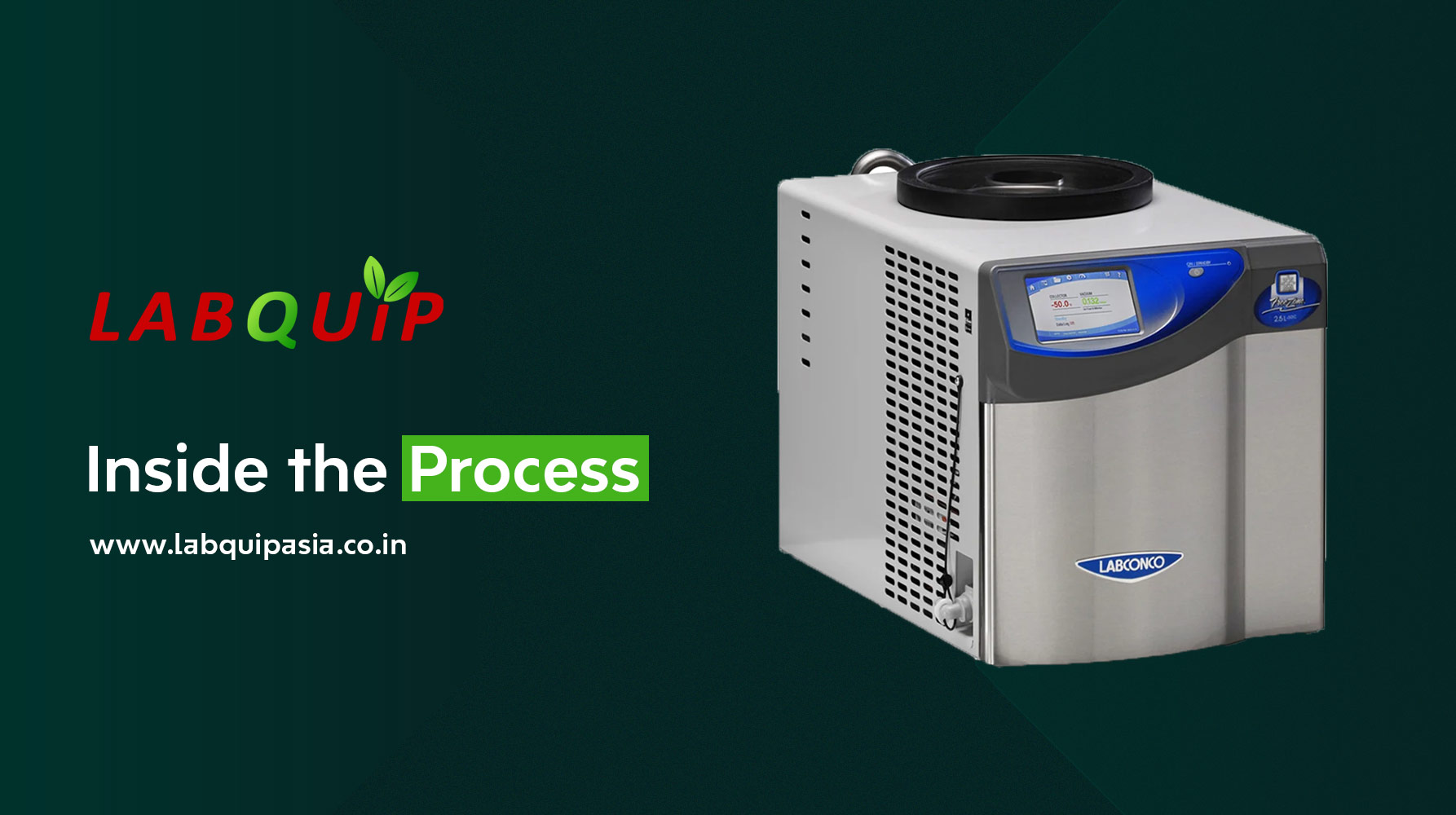
What Happens Inside a Freeze Dryer That You Can’t See?
From the outside, a freeze dryer can look surprisingly simply: a chamber, a cold collector and a vacuum system working together. But inside the system, a much more precise process is taking place. The sample is not simply being “dried.” Instead, frozen water is gradually removed through a controlled process called sublimation, followed by the removal of remaining moisture during secondary drying.
This is what makes freeze drying valuable for research laboratories, pharmaceutical applications, biotechnology and sample preservation. The visible equipment is only one part of the process. What really matters is what is happening inside the chamber, how heat and pressure are controlled, where the removed water goes and how accurately the process can be monitored.
Inside the Freeze Drying Process
The process starts with the sample being frozen. Depending on the application and freeze-dryer configuration, this freezing may take place inside the system or the sample may be pre-frozen externally before it enters the drying chamber. Once the material is frozen, the next stage is to establish controlled low-pressure conditions around it.
Under suitable temperature and pressure conditions, the ice in the frozen sample can transition directly from solid to vapour without passing through the liquid phase. This process is known as sublimation, and it forms the foundation of lyophilization.
The freeze dryer must carefully manage the conditions that allow sublimation to occur. Heat is introduced in a controlled manner to provide the energy required for sublimation, while the vacuum maintains the low-pressure environment needed for the process. This is very different from conventional evaporation, where liquid water changes into vapour.
For heat-sensitive materials, this controlled approach can help preserve the structure and characteristics of the product or sample. That is why selecting the right freeze-drying equipment involves much more than simply looking at chamber size or minimum temperature.
When Ice Turns Directly into Vapour
During primary drying, sublimation removes most of the frozen water from the sample. As heat is supplied under controlled conditions, ice within the product changes directly into water vapour. That vapour then travels away from the product through the freeze-drying system.
The rate of sublimation depends on several factors, including the characteristics of the product, product temperature, shelf or heat input, chamber pressure and collector conditions. This is why maintaining the right balance is important. Too much heat can affect the product, while insufficient energy can slow the drying process.
Once most of the visible or freely frozen ice has been removed, the process moves into secondary drying. Here, the objective changes. Instead of removing primarily frozen ice, the system works to reduce moisture that remains more strongly associated with the dried material.
This distinction matters because lyophilization is not simply one continuous drying step. Primary and secondary drying have different objectives and require different process conditions. Understanding this is also essential when evaluating a laboratory lyophilization system for a particular application.
Where Does the Water Go?
This is one of the most important things happening inside a freeze dryer—and one of the easiest to miss when looking at the machine from the outside.
When ice in the sample sublimates, the resulting water vapour does not simply disappear. It moves through the system toward the cold collector or condenser. The collector is maintained at a sufficiently low temperature so that the water vapour is captured on its cold surface and converted back into ice.
In simple terms, the journey looks like this:
Frozen sample → controlled heat input → ice sublimates → water vapour travels through the system → cold collector captures the vapour as ice → secondary drying removes remaining moisture
This collector is therefore a critical part of the freeze-drying process. It provides a destination for the water removed from the product and helps protect the vacuum system from excessive water vapour loading.
The collector temperature and the product temperature are also not the same measurement. Collector temperature describes the cold surface where vapour is captured, while product temperature describes the temperature of the material being dried. Both can provide important information about what is happening during a cycle.
Why Vacuum and Temperature Matter
Vacuum is often described as if it simply “pulls moisture out” of the sample. That is not quite what happens. The vacuum establishes the low-pressure environment required for sublimation when the appropriate temperature and pressure conditions are maintained.
At the same time, the product must remain within an appropriate temperature range for the material and process. The collector must also remain sufficiently cold to capture the water vapour leaving the product. These conditions work together rather than independently.
That is why laboratory users need more than equipment that simply reaches a low pressure or a very low collector temperature. They need visibility into the conditions throughout the cycle, including vacuum, collector temperature and, where available, product or sample temperature.
Capacity is another important consideration when selecting a laboratory freeze dryer. Labconco FreeZone systems are offered across several configurations, from 2.5 L benchtop models through larger 18 L console models. These figures refer to the collector’s ice-holding capacity, so they should not automatically be interpreted as sample volume.
The appropriate system therefore depends on the application, expected workload, sample characteristics, required collector temperature and the drying accessories or monitoring capabilities needed.
When Monitoring Becomes Essential
Here is another part of the process that cannot always be seen from outside the machine: how the conditions change while drying is taking place.
Modern lyophilization systems can provide real-time information about important operating conditions. Labconco’s Lyo-Works™ Operating System provides real-time display of collector temperature and vacuum level, while optional sample temperature sensors can provide additional visibility into the product itself. Optional End-Zone™ endpoint detection is also available.
End-Zone™ is designed to help identify the endpoint during flask freeze drying by comparing the vacuum level in a sample flask with the system vacuum. When the drying process is complete and vapour generation has ceased, the flask vacuum approaches the system vacuum, allowing the system to identify the endpoint and provide an alert.
This type of monitoring can make a meaningful difference in laboratory work. Instead of treating the process as something that simply runs for a preset amount of time, researchers can observe the conditions that influence the actual drying cycle.
For laboratories evaluating a Freeze Dryer Supplier in India, this is an important consideration. Equipment selection should go beyond basic specifications and consider process control, monitoring capabilities, collector performance, capacity and the requirements of the intended application.
From the outside, a freeze dryer may appear to be simply freezing and drying a sample. Inside, however, it is managing a carefully controlled sequence: the sample is frozen or introduced already frozen, heat is supplied to support sublimation, water vapour moves through the system, the cold collector captures that vapour as ice, and secondary drying reduces remaining moisture.
At Labquip Asia, we represent Labconco and provide access to FreeZone solutions designed for research and pilot plant laboratory requirements. When your application demands controlled lyophilization and better visibility into the drying process, understanding what happens inside the system is the first step toward selecting the right solution.
FAQs
- What is a freeze dryer used for?
A freeze dryer is used to remove moisture from frozen materials through sublimation and subsequent drying under controlled temperature and pressure conditions. It is commonly used in laboratory research, pharmaceutical applications, biotechnology and sample preservation.
- Is a freeze dryer the same as a lyophilizer?
Yes. “Freeze dryer” and “lyophilizer” are commonly used terms for equipment used to perform the freeze-drying or lyophilization process.
- What happens during primary drying?
During primary drying, frozen water in the sample undergoes sublimation, changing directly from ice into water vapour under controlled temperature and low-pressure conditions.
- Where does the water go during freeze drying?
Water removed from the sample becomes vapour during sublimation and travels toward the cold collector or condenser. The collector captures the vapour on its cold surface, where it becomes ice.
- Why is product temperature important?
Product temperature indicates the temperature of the material being dried. It is different from collector temperature and can help researchers understand whether the product is being maintained within appropriate process conditions.
- Why is vacuum important during lyophilization?
Vacuum establishes the low-pressure conditions needed to support sublimation. It does not simply “pull” liquid moisture out of the sample; sublimation occurs when appropriate pressure and temperature conditions are maintained.
- How do I select a laboratory lyophilization system?
Consider the sample type, required collector ice-holding capacity, collector temperature, vacuum requirements, expected workload, drying accessories and the level of process monitoring or endpoint detection required for your application.