The 50 mL Experiment That Can Change a 15-Litre Bioprocess
Your culture is thriving. Growth curves look beautiful, the data is clean, and the team is excited to scale up.
Then you move to a larger vessel, keep the same settings, and the culture behaves like a completely different organism.
It’s one of the most frustrating moments in bioprocess development, and it happens for a simple reason: a process that works in 50 mL does not automatically work in 15 litres. The biology didn’t change. The environment around it did.
So, what is a small-scale experiment actually good for? Quite a lot, if you design it to answer the right questions.
What a Small-Scale Bioreactor Experiment Can Tell You
Before a team commits more materials, time and budget to a larger process, they need evidence that the approach is worth pursuing. Does a temperature shift affect growth? Does the culture respond differently at a particular pH? Do the chosen conditions give consistent results?
Testing every combination of temperature, pH and agitation speed at a larger volume would be expensive and slow. A Laboratory Bioreactor lets you compare selected variables while holding everything else steady, so you can narrow your options early and decide which experiments deserve to come next.
The catch is that one good run is not proof. It could be biological variability, or an uncontrolled factor that happened to line up in your favour. Repeat the promising experiments, use proper controls, and start with a clear objective. The goal isn’t to prove success at 15 litres. It’s to build a sound basis for deciding what to investigate next.
What Changes as Volume Increases
Move from a small vessel to a larger one and the physical world your culture lives in changes. You can use the same medium and the same target conditions, but oxygen, nutrients and heat are distributed differently because vessel dimensions and fluid movement are different.
Oxygen transfer is the classic example. Picture this hypothetical scenario (an illustration, not experimental data):
- A team grows an aerobic microorganism in a small vessel at a set agitation speed. Dissolved oxygen stays comfortably in range throughout the run.
- Pleased with the result, they move to a much larger vessel and enter the same agitation speed.
- But the larger vessel has a different geometry and a different impeller. The same rpm no longer delivers the same mixing or the same gas–liquid transfer.
- As biomass climbs and oxygen demand rises, supply struggles to keep up. Dissolved oxygen drops, and growth slows.
Nothing was wrong with the organism. The “identical” setting simply wasn’t identical in practice.
Mixing and heat follow the same pattern. How well nutrients and dissolved gases reach every part of the culture, and how effectively heat is removed, can both shift with working volume. That is why scale-up isn’t a matter of multiplying the ingredients and leaving every setting alone. You need to identify which process characteristics matter for your organism and cultivation method, then watch how they behave as the vessel grows.
Turning Bioreactor Data into Decisions
A bioreactor experiment is worth more than its final number. The data collected along the way tells you how the process unfolded:
- pH trends show how the culture environment is changing.
- Dissolved oxygen reveals the balance between oxygen supply and biological demand.
- Temperature records, growth measurements and product formation add the surrounding context.
Looking at how these parameters change over time is far more useful than relying on a single endpoint.
Experimental design matters just as much. If you change several parameters at once, you may never know which one caused the difference. A structured screening approach tests selected variables systematically, and repeat runs confirm whether a finding holds.
In the end, the data should help you make a call. One set of conditions deserves a closer look. Another can be dropped. An apparent improvement needs more testing before anyone trusts it. Record the working volume, vessel configuration, operating conditions and measurement methods every time, so your runs stay comparable and you can separate what you have demonstrated from what you are still assuming.
Choosing a Laboratory Bioreactor for Your Next Scale-Up Step
Start with the research question, not the vessel capacity. The experiments you can run depend on three things:
- Working volume. A small working volume suits early screening, where you want to compare several conditions without using large amounts of medium and materials. A larger volume suits process-development work, where you need to see how the culture behaves closer to the scale you are heading towards.
- Monitoring. If you want to understand oxygen supply and demand, you need to see dissolved oxygen as it changes. If pH drift is a concern, you need to track it through the run, not just at the end.
- Control. Holding temperature, pH and dissolved oxygen at defined setpoints is what lets you change one variable at a time and trust the comparison.
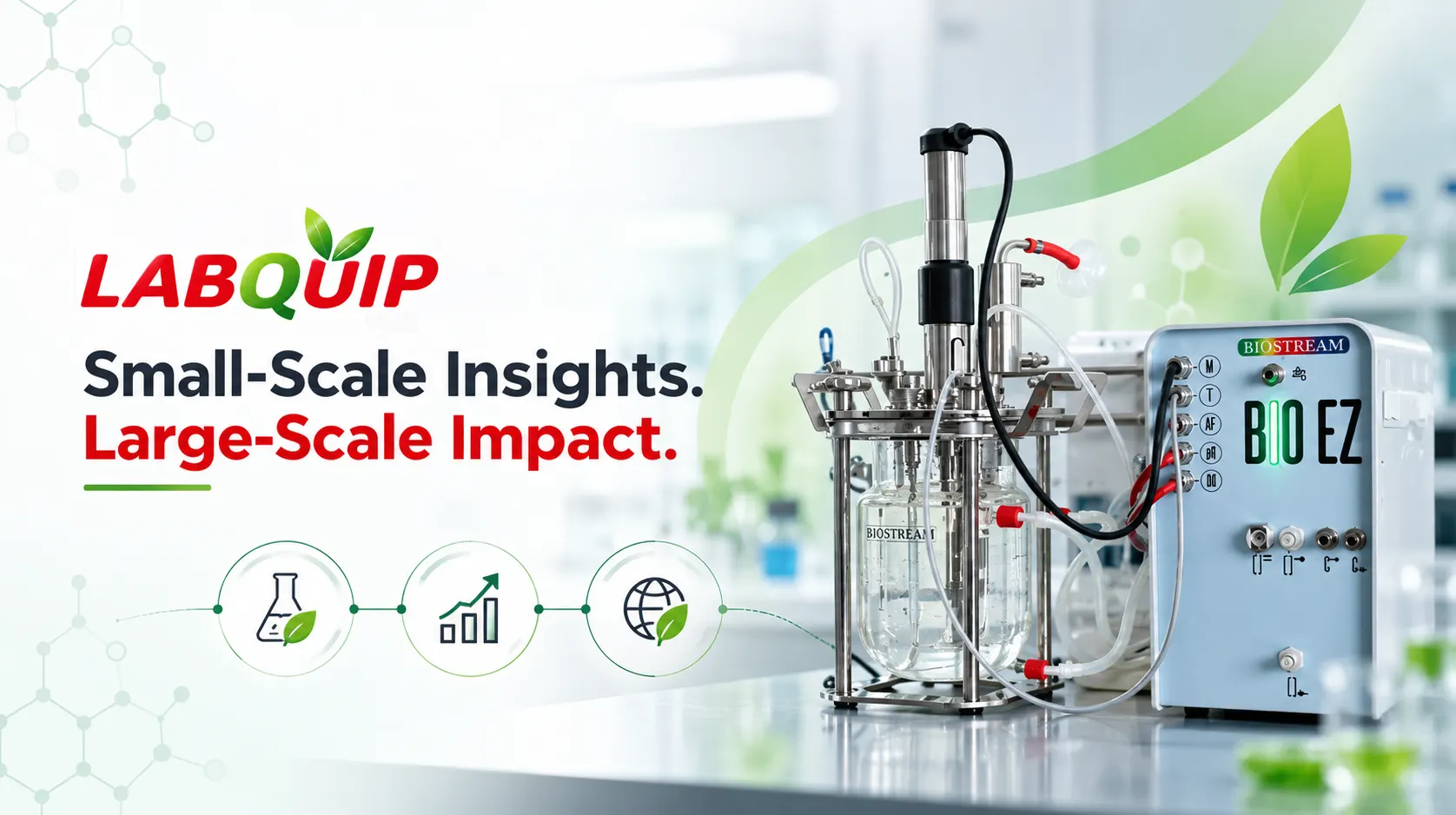
BioStream laboratory bioreactor systems, represented by Labquip Asia, are available in working volumes from 50 mL to 15 litres, covering laboratory research, cultivation studies and process development. Depending on the configuration, control capabilities include pH, temperature and dissolved oxygen. That range lets a laboratory start small and screen conditions, then move up in volume while keeping a consistent approach to monitoring and control.
As a laboratory equipment supplier in India, Labquip Asia can help you match a BioStream bioreactor or fermenter configuration to your application, working volume and control requirements.
Planning a cultivation study or evaluating equipment for bioprocess development? Explore the BioStream bioreactor and fermenter systems represented by Labquip Asia and find a configuration that suits your laboratory.
FAQs
1. Why is small-scale bioreactor testing important?
It helps researchers screen conditions, compare variables and identify promising approaches before moving to larger volumes.
2. Why can a process behave differently at a larger scale?
Changes in oxygen transfer, mixing, heat removal and vessel geometry can affect culture growth and product formation.
3. Which parameters should be monitored during a bioreactor experiment?
Key parameters include pH, dissolved oxygen, temperature, growth and product formation.
4. How do you improve the reliability of bioreactor experiments?
Use proper controls, repeat promising experiments and change selected variables systematically to identify their effects.
5. What working volumes are available in BioStream bioreactor systems?
BioStream laboratory bioreactor systems represented by Labquip Asia are available in working volumes ranging from 50 mL to 15 litres.