
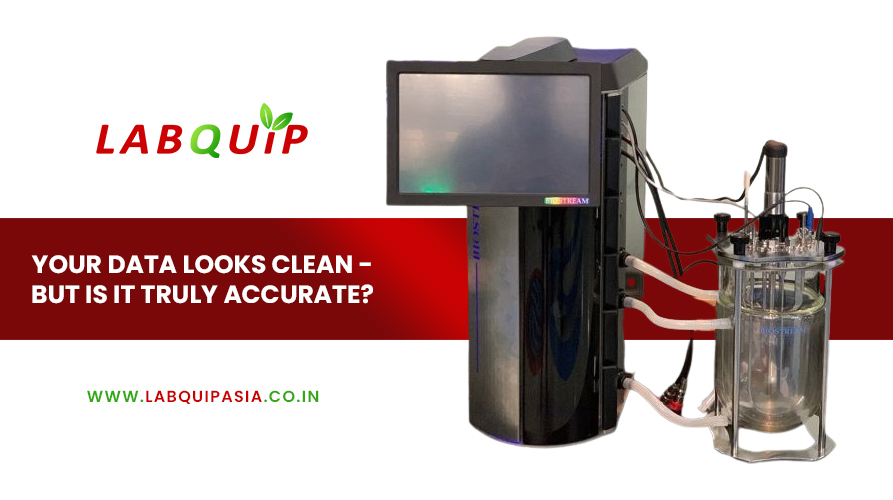
Laboratory Bioreactor Systems: Are Your Results Truly Reliable?
Every laboratory running a bioreactor operates with a quiet assumption—the system is working. It’s rarely questioned. The parameters look stable, the readings stay within range, and the laboratory bioreactor systems in India in place seem to be doing exactly what they were designed for. On the surface, everything appears controlled.
But here’s the question most teams never pause to ask: Is “working” actually the same as being reliable? Because in research, where consistency defines progress, that assumption can quietly become the weakest point in the entire workflow.
The Assumption Every Laboratory Makes About Bioreactors
In most labs, performance is judged by stability on the surface. If nothing breaks and readings look acceptable, the system is considered reliable.
But consistency isn’t about appearing stable—it’s about delivering the same outcome, every single time.
When “Working Fine” Isn’t the Same as Being Reliable
There’s a critical difference between a system that runs and a system that performs with precision. Many labs operate in that in-between space where their lab bioreactor systems function well enough to proceed—but not accurately enough to eliminate uncertainty.
A slight drift in pH, a small fluctuation in dissolved oxygen, or minor temperature instability may seem insignificant in isolation. But over time, these variations begin to shape outcomes.
This is where controlled fermentation systems move from being a feature to a necessity. Because when control is partial, results are too. And when results vary, confidence begins to erode—even if no one openly acknowledges it.
Hidden Limitations Inside Laboratory Bioreactor Systems
In most laboratory environments, inconsistencies do not appear as failures. They emerge gradually—quietly embedded within the system.
A delayed response in pH adjustment, slight instability in temperature regulation, or limitations in a bioreactor with pH and DO control can create deviations that are easy to overlook in the moment but difficult to correct later.
Even a 0.2 pH deviation can significantly impact yield in sensitive cultures, subtly altering outcomes while remaining undetected within standard monitoring ranges.
🔸 pH Control and Its Impact on Results
Small pH shifts directly affect reaction stability and growth conditions, leading to inconsistent outputs.
🔸 Dissolved Oxygen (DO) Fluctuations
Variations in oxygen levels disrupt metabolic processes, impacting culture performance.
🔸 Temperature Instability in Bioreactors
Even minor temperature changes can influence experimental accuracy and reproducibility.
Why Lab-Scale Bioreactors Often Lead to Repetition
There’s a familiar pattern across labs working with lab-scale bioreactors (50 ml to 15L). An experiment runs, results are reviewed, and then comes the unspoken step—“let’s repeat it once more.”
Over time, repetition becomes normalized.
But repetition is not always validation. In many cases, it’s a signal that consistency is missing at the system level. When outcomes shift despite following the same process, the issue may not lie in execution—but in the stability of the environment itself.
Inconsistent Data: Process Issue or System Limitation?
When results vary, the natural instinct is to question the process—adjustment parameters refine methods and run additional trials.
But what if the process isn’t the real issue?
Many laboratories unknowingly adapt their workflows around system limitations. Instead of eliminating variability, they manage it. And in doing so, valuable time, effort and resource are lost.
Reliable bioreactor system for research don’t just support experiments—they ensure outcome remain stable, repeatable and trustworthy.
What Affects Bioreactor Result Consistency?
Several factors directly influence how dependable your bioreactor results truly are:
🔸 Key Factors That Influence Performance
- pH control: Fluctuations impact reaction stability
- Dissolved oxygen (DO): Inconsistent levels disrupt metabolic processes
- Temperature regulation: Minor deviations alter outcomes
- System scalability: Misalignment between lab-scale and larger systems
When these elements are not precisely maintained within laboratory bioreactor systems, results may appear acceptable—but fail to remain consistent across repeated experiments.
What Modern Laboratories Expect from Bioreactor Systems
The expectations around research systems have evolved. Laboratories are no longer satisfied with setups that simply function—they require systems that deliver reproducibility and control with minimal intervention.
This shift has led to increasing adoption of advanced laboratory bioreactor systems designed to maintain stability across all critical parameters.
Modern systems reduce variability, improve reproducibility, and support scalability—ensuring consistent outcomes rather than adjustable ones.
Laboratory Bioreactor Systems Price: What Really Matters?
When evaluating bioreactor systems price, most labs focus on upfront investment. But the real cost goes far beyond acquisition.
Lower-cost lab bioreactor systems may seem viable initially, but hidden inefficiencies—parameter instability, limited scalability, and repeated recalibration—gradually increase operational expenses.
The true cost of a system is not what you pay to buy it—but what you lose when results fail to remain consistent.
How to Choose the Right Bioreactor Supplier in India
Selecting a bioreactor supplier in India is not just a procurement decision—it’s a long-term investment in research reliability.
What to Look for in a Reliable Supplier
- Stable pH and DO control under real conditions
- Scalable system design
- Consistent performance across experiments
🔸 Performance vs Price: Making the Right Decision
While price matters, consistency matters more. A dependable system reduces repetition, protects timelines, and improves overall research efficiency.
The Role of the Right Bioreactor Supplier in Research Accuracy
Choosing the right supplier is a strategic decision. A capable supplier provides systems that align with real laboratory demands—offering consistency, control, and scalability without constant adjustment.
With the right laboratory bioreactor systems supplier, the focus shifts back to research. Processes become clearer, outcomes stabilize, and the need for repeated validation begins to reduce.
Moving from Assumption to Confidence in Bioreactor Results
There comes a point where assumption is no longer enough. Laboratories begin to seek certainty—not just results that appear correct, but results that remain consistent every time.
That level of confidence does not come from endlessly refining processes—it comes from relying on systems designed for stability from the start.
Confidence in research is not built on isolated success. It is built on consistency.
Ready to Eliminate Inconsistency?
Still repeating experiments? Your system might be holding you back.
Upgrade to consistency with advanced laboratory bioreactor systems designed for reliable, repeatable results.
FAQs About Laboratory Bioreactor Systems
1: What is a laboratory bioreactor system used for?
It is used to control biological processes like fermentation, cell culture and microbial growth under stable conditions.
2: How do I choose the right bioreactor supplier in India?
Focus on system stability, scalability and real-world performance—not just specification or price.
3: What affects bioreactor result consistency the most?
pH control, dissolved oxygen, temperature stability and system responsiveness.
4: What is the typical bioreactor systems price in India?
Pricing depends on capacity, automation and control features, but long-term reliability matters more than upfront cost.
5: Why do labs repeat experiments in bioreactors?
Most repetitions occur due to hidden system inconsistencies rather than process errors.