
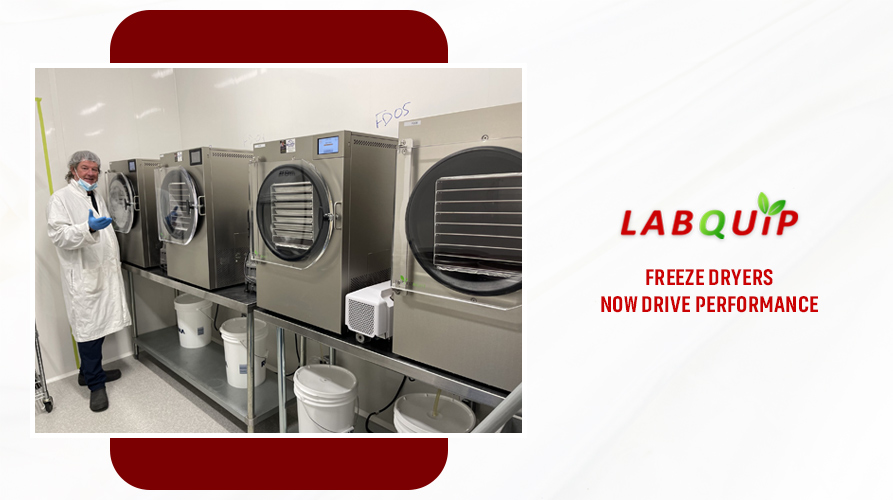
Freeze Dryers Are No Longer Support Equipment
They’re Becoming Core Lab Infrastructure
Laboratories are quietly redrawing their equipment priorities. What once sat in the background of research workflows is now moving to the center of operational decision-making. Freeze Dryers are no longer viewed as supporting hardware; they are increasing treated as foundational laboratory infrastructure.
This shift is not driven by trends or aesthetics. It is driven by accountability. Research outcomes today demand stability, repeatability and transparent process control. Freeze drying sits at the crossroads of all three.
Why Laboratories Are Re-Evaluating Their Freeze Dryers
Research environments have changed. Sample sensitivity has increased. Regulatory scrutiny has tightened. Pilot laboratories are expected to deliver outcomes that translate smoothly into scale-up processes.
In this environment, Freeze Dryers are expected to do more than preserve material. They are expected to safeguard data integrity. Laboratories are moving away from assumption-based operation towards systems that provide continuous insight into freeze-drying cycle.
Freeze Dryers for Research Laboratories Are No Longer Optional Equipment
In research laboratories, freeze drying directly impacts the stability of biological samples, formulations and experimental materials. Any deviation in temperature or vacuum behaviour can compromise weeks of work.
Modern Freeze Dryers for research laboratories are selected not only for performance, but for control visibility. Real-time access to process parameters allows researchers to operate with confidence rather than inference. This is precisely why Freeze Dryers are now treated as essential laboratory assets rather than secondary tools.
How Freeze Dryers Support Both Research and Pilot Plant Laboratories
The line between research laboratories and pilot plant facilities is becoming thinner. Experiments initiated at bench scale are expected to transition smoothly into pilot workflows.
Freeze Dryers designed to support capacities ranging from 2.5L to 18L provide laboratories with the flexibility to evolve without changing platforms. Smaller capacities allow controlled experimentation, while higher volumes support pilot validation and process optimization.
For laboratories planning long-term growth, Freeze Dryers for pilot plant laboratories offer continuity rather than compromise.
Real-Time Monitoring Is Redefining Expectations from Freeze Dryers
One of the most significant changes in laboratory expectations is the demand for visibility. Modern Freeze Dryers now provide:
- Large screen displays for intuitive operation
- Real-time collector temperature tracking
- Continuous vacuum level monitoring
This information is no longer viewed as supplementary. It is critical. Operators rely on live data to make informed adjustments, reducing uncertainty during freeze-drying cycles.
Freeze Dryers with real-time monitoring empower laboratories to shift from reactive correction to proactive control.
Freeze Dryers with End-Point Detection Are Reducing Process Uncertainty
Over-processing and under-processing are silent risks in lyophilization. Optional end-point detection systems address this challenge directly by indicating when the process has reached its intended conclusion.
For laboratories managing sensitive materials, Freeze Dryers with end-point detection reduce variability and help preserve sample integrity across repeated cycles. This capability is especially valuable in pilot environments where consistency defines scalability.
Choosing the Right Freeze Dryer Capacity for Your Laboratory Workflow
Capacity selection is not a technical detail; it is a strategic decision. Laboratories often underestimate how quickly research demands evolve.
- 2.5L systems support early-stage research and controlled studies
- Mid-range capacities accommodate expanding workloads
- 18L Freeze Dryers support pilot-scale validation and process trials
Selecting the right capacity ensures laboratories operate efficiently today while remaining prepared for tomorrow.
Labquip Asia as a Trusted Supplier of Freeze Dryers in India
As a supplier of Freeze Dryers in India, Labquip Asia supports laboratories that value reliability, scalability, and operational clarity. The focus is not limited to equipment delivery; it extends to understanding laboratory workflows and long-term research objectives.
By supplying Freeze Dryers engineered for research and pilot environments, Labquip Asia enables laboratories to maintain control across every stage of lyophilization.
The Future of Laboratory Operations Is Closely Tied to Freeze Dryers
Freeze drying is no longer a background process. It is a defining factor in research credibility, pilot reproducibility, and laboratory efficiency.
As laboratories continue to raise their standards, Freeze Dryers will remain central to how research is preserved, validated, and scaled.
Labquip Asia supplies Freeze Dryers tailored for research and pilot plant laboratories, offering scalable capacities and advanced process visibility. Connect with Labquip Asia to align your lyophilization needs with laboratory objectives that demand consistency and control.
FAQs
Q1. What are Freeze Dryers mainly used for in laboratories?
Freeze Dryers are used to preserve sensitive samples by removing moisture while maintaining structural integrity.
Q2. Are Freeze Dryers suitable for both research and pilot plant laboratories?
Yes, Freeze Dryers with scalable capacities support early research as well as pilot-scale validation.
Q3. What capacity Freeze Dryer should a research lab consider?
Capacity depends on workload volume, with options typically ranging between 2.5L and 18L.
Q4. Why is real-time monitoring important in Freeze Dryers?
Live temperature and vacuum data help laboratories maintain control and reduce process variability.
Q5. Does Labquip Asia supply Freeze Dryers across India?
Yes, Labquip Asia supplies Freeze Dryers to laboratories across India, supporting research and pilot applications.