
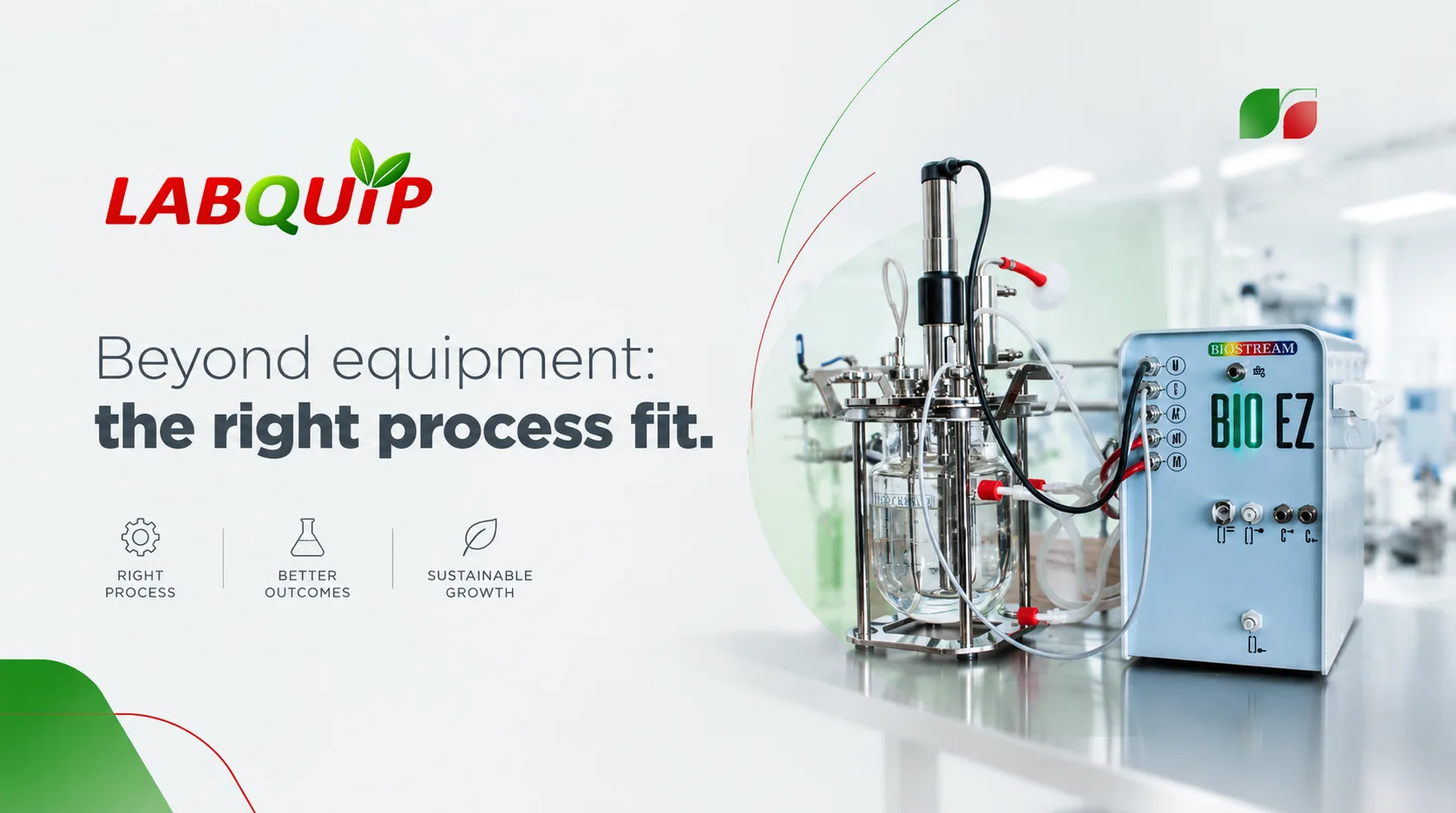
The Right Bioreactor Supplier Does More Than Supply Equipment
You walk into the supplier conversation with a clear process in mind.
Ten minutes later, you are buried in specs: vessel size, sensors, agitation, automation, accessories, price.
All useful. None of it answers the real question: will this system actually fit my process?
Because not every process plays by the same rules. Microbial fermentation needs one setup. Mammalian cell culture needs another. Algae bring light into the equation. And what works beautifully at lab scale can behave very differently at pilot or production scale.
That is why a bioreactor supplier should be a partner who understands your application, not just someone who ships equipment.
Start With Your Process, Not the Catalogue
A good supplier will ask you things like:
- What are you cultivating, and why?
- What working volume do you need?
- Which parameters need constant monitoring?
- Will this process need to scale up later?
The answers change the whole configuration:
- Some lab work needs tight control of pH, temperature and dissolved oxygen.
- Microbial cultivation may depend on agitation and aeration for oxygen transfer.
- Sensitive mammalian or insect cells need a sterile, gently mixed environment.
That is when a laboratory bioreactor stops being just a vessel. It becomes a controlled space where you can see how process parameters shape biological results.
Biostream laboratory bioreactors cover 50 ml to 15 litres, for research, cultivation studies and process development.
But volume is just one line on the spec sheet. The control and monitoring matter just as much.
The Details That Decide Your Results
The vessel holds the culture. The control system creates the conditions it grows in.
pH, temperature, dissolved oxygen, agitation and aeration all affect performance. Sensors tell you what is happening. The controller keeps it on track.
Take dissolved oxygen. In an aerobic process, running short can slow growth. More agitation or aeration can help, but only if the organism can handle it. And a larger working volume changes how things mix and how gases move.
Temperature and pH follow the same logic. Holding a number is easy. Holding the right number, with the right control strategy, is the real job.
So, a good supplier talks about working volume, cultivation conditions, sensors and future growth, not just vessel size.
What you are really buying is repeatability: the ability to see what is happening, recreate good results and adjust with confidence.
One Size Does Not Fit Every Culture
- Microbial work: laboratory fermenters and larger fermentation systems, with temperature, pH, agitation, aeration and dissolved oxygen monitored.
- Mammalian and insect cells: cell culture bioreactors, built for sensitive cells that need sterile, controlled conditions.
- Algae: photobioreactors, where light is part of the process. Biostream systems combine LED lighting, gas mixing and temperature regulation.
Algae cannot be handled like a regular fermentation, because light is now part of the environment.
A wide range is good. Knowing which setup suits your process is better.
So, skip “What equipment do you supply?” and ask:
“Can you understand my process and recommend the right system around it?”
Support Should Not Stop at Delivery
Processes grow. A lab success can turn into a pilot run, then a production plan.
But scaling up is not simply buying a bigger vessel. Mixing, oxygen transfer, heat transfer and gas distribution can all behave differently as volume rises. That is where pilot-scale fermenters come in.
Biostream supports the full journey: pilot systems from about 15 litres to several hundred litres, and production systems up to 15 m³. Larger systems can also include Clean-In-Place (CIP) and Ultra-High Temperature (UHT) options, depending on the application.
Some processes need something more specific. A custom bioreactor system can beat forcing a standard setup onto a process that does not fit it.
The best supplier knows where your process is today, what it needs now and where it is heading next.
Because the right choice is rarely about the vessel alone. It is about how well the whole system fits your process.
Looking for the Right Bioprocess System?
Research, fermentation, cell culture, algae or scale-up, it all starts with understanding your application.
Labquip Asia represents a range of bioreactors, fermenters and photobioreactors across laboratory, pilot and production scales. Share your working volume, parameters and goals with the team and find a system built around your process.
FAQs
- What should you look for in a bioreactor supplier?
Application expertise, suitable configurations, process control, customisation and scale-up support.
- What is a laboratory bioreactor used for?
Research, cultivation studies, process development and optimisation at lab scale.
- What are fermenters used for?
Controlled microbial fermentation and process development.
- What are photobioreactors used for?
Controlled cultivation of photosynthetic organisms such as algae.
- Can bioreactor systems be customised?
Yes. They can be configured for your application, working volume, monitoring and process needs.