
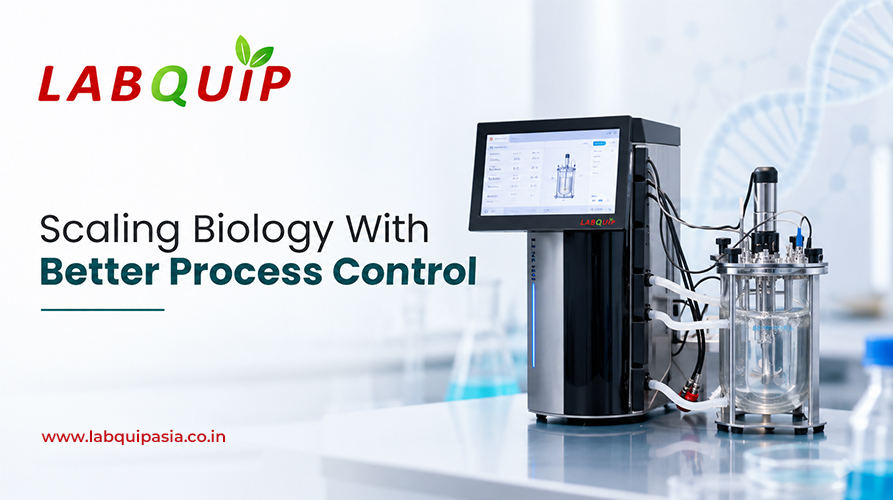
Your Fermentation Worked in the Lab. Will It Scale?
A fermentation process can perform perfectly in a laboratory and still behave differently when moved to a larger system. That is one of the most important challenges in bioprocess development and it is easy to underestimate.
At laboratory scale, everything is easier to observe and control. The vessel is smaller, mixing happens quickly, temperature changes can be managed efficiently, and oxygen can reach the culture relatively easily. Then the volume increases, and suddenly the same process has to work under very different physical conditions.
The biology has not changed. The environment around it has.
That is why fermentation scale-up is not simply a matter of increasing the working volume. It is about maintaining the conditions that allowed the original process to succeed.
When Laboratory Fermentation Stops Scaling
A successful laboratory batch can create the impression that the process is already solved. But laboratory fermentation is often only the first stage of a much larger development journey.
As the vessel becomes larger, factors such as mixing time, oxygen transfer, heat removal, agitation and nutrient distribution can change significantly. A microorganism that received sufficient oxygen in a small laboratory fermenter may experience different oxygen availability at pilot scale. Similarly, temperature and pH can become harder to maintain uniformly throughout a larger working volume.
This is where scale-up becomes a process engineering challenge rather than simply an increase in capacity.
The important question is not, “Can we make the vessel bigger?” It is, “Can we maintain the same critical process conditions at the larger scale?”
That distinction can determine whether a fermentation process moves smoothly toward production or requires extensive redevelopment.
What Changes Inside Fermenters
Inside a fermenter, microorganisms respond continuously to their surrounding conditions. They do not care whether the vessel contains one litre or several hundred litres. They respond to oxygen, temperature, pH, nutrients, agitation and other environmental conditions available to them.
Increasing the volume can therefore change how quickly and evenly these conditions are distributed.
Mixing becomes particularly important. A larger vessel may require different agitation strategies to achieve effective circulation. Oxygen transfer can also become more challenging because the culture’s oxygen demand may increase while gas-liquid transfer behaves differently at scale. Heat generated during biological activity must be managed, while pH and nutrient conditions need to remain within the required operating range.
This is why modern fermenter systems are built around much more than a vessel. They combine cultivation space with sensors, control systems, gas management, agitation and process monitoring.
A laboratory fermenter helps establish the process. A larger bioprocess fermenter must help maintain that process under changing physical conditions.
Why Pilot-Scale Fermenters Matter
This is where pilot-scale fermenters become important. They provide an intermediate environment between laboratory development and full production, allowing researchers and process engineers to evaluate how a fermentation process behaves at increased volume.
Biostream systems, represented by Labquip Asia, include pilot-scale configurations from approximately 15 L to several hundred litres, along with larger production systems. These platforms are designed to maintain monitoring and control as the process moves beyond laboratory scale.
For example, the BioTwin Pilot supports working volumes of approximately 15–50 L and provides control and monitoring for parameters including temperature, pH, dissolved oxygen, agitation, gas flow, pressure and biomass. Larger BioPilot systems extend fermentation capabilities into substantially higher working volumes.
The value of this approach is not simply having more litres available. It is being able to observe how the process behaves when mixing, oxygen transfer, heat management and control requirements become more demanding.
That information can help identify scale-up problems before they become production problems.
Control Matters Beyond Volume
A reliable fermentation process depends on what happens inside the vessel, but also on how effectively those conditions are monitored and controlled.
Modern fermenter equipment can integrate sensors, pumps, gas flow control, agitation systems and automated process functions into one operating environment. This allows critical parameters to be monitored continuously rather than checked only at individual points during a batch.
Software also plays an important role. Bioprocess control platforms such as BOS 3.0 are designed to manage recipes, process parameters, device integration and data management across different scales. Maintaining consistent process logic between laboratory, pilot and production systems can make scale-up more structured and repeatable.
Ultimately, the right fermenter is not determined by capacity alone. Working volume matters, but so do the microorganism or cell type, oxygen requirements, agitation, monitoring requirements, sterilization approach and future scale-up plans.
Because when fermentation moves from the laboratory to pilot or production scale, the vessel gets bigger—but the process has to remain under control.
Build Your Bioprocess with Better Control
Whether you are developing a microbial fermentation process, working with cell cultures or preparing for scale-up, the right fermenter system can make a significant difference to process development.
Labquip Asia represents Biostream fermentation and bioreactor systems designed for laboratory, pilot and production-scale applications.
Talk to Labquip Asia to discuss the fermenter configuration that fits your process and scale-up requirements.
FAQs
What is a fermenter used for?
A fermenter provides controlled conditions for growing microorganisms or biological cultures while managing parameters such as temperature, pH, oxygen and agitation.
Why does fermentation change at larger scale?
Larger volumes can affect mixing, oxygen transfer, heat management, nutrient distribution and overall process control.
What is a pilot-scale fermenter?
A pilot-scale fermenter allows a process developed at laboratory scale to be evaluated at a larger volume before moving toward production.
Which parameters are commonly controlled?
Typical parameters include pH, temperature, dissolved oxygen, agitation, gas flow, pressure and biomass.
How should a fermenter system be evaluated?
Consider working volume, culture type, oxygen demand, monitoring requirements, automation, sterilization and future scale-up needs.
Are fermenters and bioreactors the same?
The terms are often used interchangeably, although “bioreactor” is a broader term covering different types of biological cultivation systems.