
Antibiotic Zone Reader: Technical Features That Matter
Measuring a zone of inhibition may look straightforward on an agar plate. In practice, the analysis can become considerably more demanding when plates contain closely positioned colonies, similar colours, uneven contrast or areas that should not be included in the count. Add different plate formats, repeated measurements and reporting requirements, and the task becomes more than simply looking at a plate and recording a diameter.
This is why selecting an antibiotic zone reader should involve more than checking whether an instrument can measure a zone. Laboratories need to consider how the system handles different plate configurations, identifies and differentiates colonies, manage difficult images, processes multiple plates and produces usable results. For pharmaceutical microbiology and quality-control environments, those capabilities can influence how smoothly the entire analytical workflow operates.
Start With Plate Flexibility
A laboratory rarely works with one identical plate configuration for every application. Depending on the assay and testing protocol, the relevant information may occupy an entire plate, a half-plate, a quadrant or a specifically defined region. An automated reader that only works around one fixed reading format can therefore become restrictive rather quickly. Flexibility in defining the area of analysis is particularly useful when the laboratory needs to adapt the reading process to different plate layouts without changing the fundamental workflow.
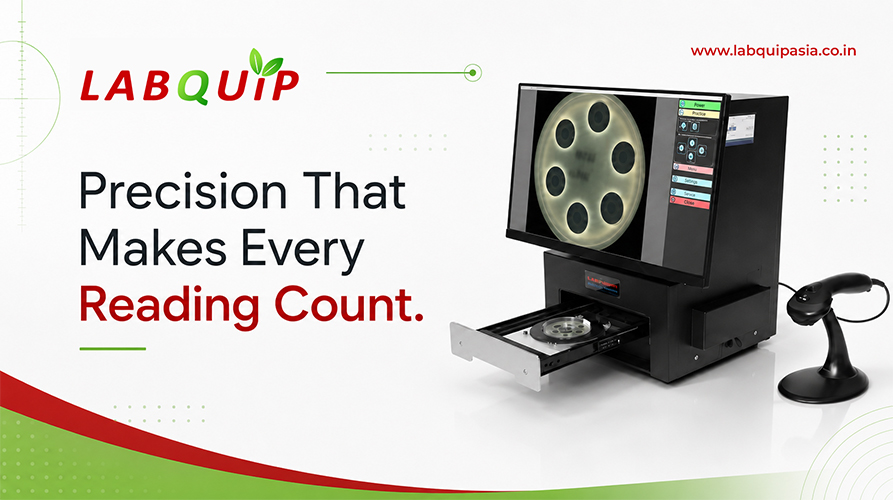
The Giles Scientific TRINITY V3, represented by Labquip Asia, is designed to read plates up to 150 mm and provides options for reading the entire plate, half-plate, quadrants or custom-defined areas. This allows the operator to specify the portion of the plate that needs to be analysed rather than treating every visible region as relevant data. The ability to adjust the counted area can also help exclude plate rims and ridges that should not form part of the analysis.
That flexibility matters because plate analysis is rarely as neat as a simplified diagram suggests. The useful question is not simply, “Can the instrument read this plate?” It is, “Can the instrument read this plate in the way my laboratory actually needs to analyse it?” That distinction becomes increasingly important when evaluating equipment for routine microbiological testing.
Antibiotic Zone Reader Capabilities
An antibiotic zone reader has a fundamental job: convert what is visible on a microbiological plate into measurable information. But the quality of that workflow depends on considerably more than obtaining a single measurement. The system also needs to deal with colonies that differ in size, colonies that appear visually similar, and images where the boundaries are not immediately obvious.
The TRINITY V3 provides several capabilities designed around these practical conditions. It can differentiate colonies based on size and distinguish counted colonies based on colour similarities. Its contrast settings can also be adjusted when a plate is difficult to read. These functions are important because image analysis becomes more complicated when the visual distinction between colonies is not straightforward. A fixed image-processing approach may not be suitable for every plate, whereas adjustable analysis gives the operator greater control over the reading conditions.
The system also provides a stated smallest detectable colony size of 0.05 mm and a smallest size discrimination of 0.08 mm. These specifications describe the instrument’s stated detection and discrimination capabilities and are particularly relevant when evaluating systems for detailed colony analysis. The TRINITY V3 can also separate touching colonies into multiple counts, while allowing the operator to manually add or delete colonies when correction is required. These manual interventions are marked in a different colour, making the adjustment distinguishable within the analysis.
That combination of automation and controlled operator intervention is worth noting. Automation does not mean pretending every plate is perfect. A useful laboratory system should provide automated analysis while still allowing the trained operator to intervene when the biological image requires judgement.
Control Difficult Plate Analysis
The real test of an automated reader often begins when the plate is difficult rather than ideal. Colonies can touch one another, colour differences can be subtle and the usable analysis area may need to exclude parts of the plate. These situations are not necessarily unusual exceptions; they are part of working with real biological samples.
Consider touching colonies. If two colonies appear as a single visual mass, simply counting connected shapes may not provide the required result. The ability to separate touching colonies into multiple counts gives the operator another level of control over the analysis. Similarly, when colonies have similar colours, size and colour-based differentiation can help the system distinguish counted colonies according to the configured criteria.
Contrast adjustment addresses another practical challenge. A plate that is easy to interpret visually under one set of conditions may not present equally clear image information to an automated analysis system. Adjustable contrast allows the operator to modify the image conditions when a plate is difficult to read. The ability to adjust the counted area also provides a way to exclude plate rims, ridges or other regions that should not contribute to the count.
These capabilities illustrate an important principle when selecting an automated antibiotic zone reader: automation should be judged by how well it handles variation. A laboratory does not need technology merely because it can process a perfect plate. It needs technology that remains useful when the plate presents the kinds of visual and analytical complications that occur during actual laboratory work.
Build Better Laboratory Workflows
Measurement is only one part of laboratory analysis. Once plates have been read, laboratories may need to compare multiple results, average counts, generate reports and maintain a consistent format for documentation. This makes workflow capability just as relevant as the measurement function itself.
The TRINITY V3 supports averaging multiple plate counts, which can be useful when analysis involves multiple plates rather than a single isolated reading. It also allows users to customise plate-reading formats and printout formats. Instead of forcing every laboratory to work with a single presentation style, these options provide flexibility in how the analysis is configured and how the resulting information is presented.
On-screen instructions provide additional guidance during operation. While this may sound like a small feature, usability matters when laboratory equipment becomes part of a repeated workflow. A technically capable instrument still needs to be practical for the people operating it day after day. Good laboratory technology is not only about what happens inside the instrument; it is also about how naturally the system fits into the operator’s working process.
For pharmaceutical microbiology and QA/QC environments, these workflow considerations become especially relevant. When evaluating antibiotic potency assay equipment, laboratories should look beyond the basic ability to measure an inhibition zone. Plate compatibility, configurable analysis areas, colony differentiation, image adjustment, manual correction, multiple-plate analysis and reporting flexibility all contribute to how the system can be integrated into laboratory operations.
Why Labquip Asia Matters
Selecting laboratory equipment is ultimately a technical and operational decision. A specification sheet can tell you what an instrument is designed to do, but the more important question is whether those capabilities correspond with the laboratory’s actual testing requirements. This is particularly relevant when evaluating an antibiotic zone reader in India, where laboratories may need a combination of application suitability, equipment capability and supplier support.
Labquip Asia represents Giles Scientific and offers the TRINITY V3 as an automated plate-reading solution for laboratories looking to strengthen their microbiological analysis workflow. Its combination of flexible plate handling, configurable reading areas, colony differentiation, contrast adjustment, touching-colony separation, fine detection capability, multiple-plate averaging and customised reporting gives laboratories a broader set of tools for plate analysis.
The right selection process should therefore begin with the laboratory itself. What plate sizes do you routinely use? Do you need full-plate, quadrant or custom-area analysis? How often do touching colonies or similar colours complicate counting? Do you need to average multiple plate counts? How should your results be formatted and documented? Answering these questions creates a much clearer basis for evaluating an automated antibiotic zone reader than simply comparing instruments by one headline specification.
For laboratories considering a move toward automated zone measurement and digital plate analysis, the Giles Scientific TRINITY V3 through Labquip Asia provides a solution worth evaluating against those practical requirements.
Looking for the Right Antibiotic Zone Reader?
The right laboratory equipment should support the way your team actually works. If you are evaluating an automated antibiotic zone reader for zone measurement, colony analysis or microbiological testing, Labquip Asia can help you assess the Giles Scientific TRINITY V3 against your laboratory’s application and workflow requirements.
Contact Labquip Asia to discuss your antibiotic zone-reading requirements and explore the right solution for your laboratory.
Frequently Asked Questions
Que.1: What is an antibiotic zone reader used for?
Ans: An antibiotic zone reader is used to analyse and measure zones produced on microbiological plates, including zones of inhibition associated with antibiotic testing and related microbiological assays. Advanced systems can also provide colony counting, differentiation, image adjustment and reporting functions.
Que.2: What should I consider when choosing an antibiotic zone reader?
Ans: Consider plate-size compatibility, configurable reading areas, zone and colony measurement capabilities, image contrast adjustment, colony differentiation, touching-colony separation, manual correction options, multiple-plate averaging and reporting flexibility. The equipment should also align with the laboratory’s specific testing workflow.
Que.3: Can the TRINITY V3 read different plate areas?
Ans: Yes. The Giles Scientific TRINITY V3 can read an entire plate, half-plate, quadrants or custom-defined areas. The counted area can also be adjusted to exclude plate rims and ridges.
Que.4: What is the smallest colony the TRINITY V3 can detect?
Ans: The TRINITY V3 has a stated smallest detectable colony size of 0.05 mm and a smallest size discrimination of 0.08 mm.
Que.5: Can the system handle touching colonies?
Ans: Yes. The TRINITY V3 can separate touching colonies into multiple counts. It also allows the operator to manually add or delete colonies, when necessary, with manual changes marked in a different colour.
Que.6: Who supplies Giles Scientific equipment in India?
Ans: Labquip Asia represents Giles Scientific and supplies laboratory solutions including the TRINITY V3 automated plate-reading system. Laboratories can contact Labquip Asia to discuss equipment suitability for their specific application.