
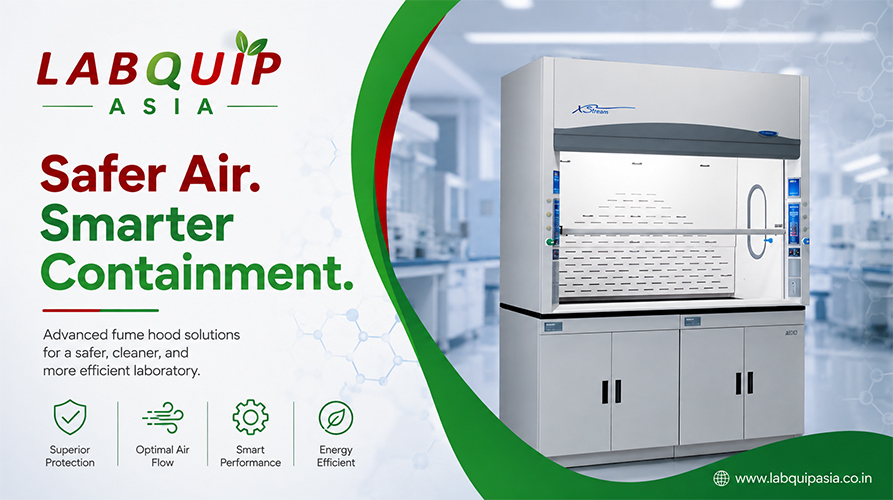
Laboratory Fume Hood Technologies: Why Smart Containment is Redefining Laboratory Safety
Every laboratory handling hazardous chemicals depends on a Laboratory Fume Hood to protect researchers from toxic vapors, harmful gases and chemical aerosols, yet many laboratories continue to rely on conventional exhaust-based systems designed decades ago, even though today’s pharmaceutical, biotechnology, research, academic and industrial laboratories demand significantly higher levels of containment and monitoring.
The reality is that laboratory safety is no longer determined by how much air a hood exhausts. It depends on how effectively the system contains contaminants before they reach the operator’s breathing zone. Industry standards such as ASHRAE 110 evaluate containments using face velocity measurements, smoke visualization and tracer gas testing because face velocity alone does not guarantee safety. Modern high-performance fume hoods are engineered to maintain excellent containment while operating at lower airflow, reducing energy consumption without compromising protection.
Modern laboratory containment has evolved beyond traditional exhaust systems. Today’s smart containment solutions combine optimized airflow, intelligent filtration, real-time monitoring and application-specific enclosure to improve laboratory safety, operational efficiency and regulatory compliance.
Laboratory Airflow Saves Lives
A Chemical Fume Hood is far more than an exhaust cabinet. It is a precisely engineered Laboratory ventilation system designed to capture hazardous chemical vapors before they escape into the laboratory environment. Poor airflow patterns, excessive cross drafts, incorrect sash positions or improper hood selection can significantly reduce containment efficiency, increasing the risk of operator exposure.
This is why leading laboratories evaluate more than airflow volume. Modern standards focus on containment performance using ASHRAE 110, the globally recognized method for laboratory fume hood testing. The protocol includes face velocity measurements, smoke visualization, and sulfur hexafluoride (SF₆) tracer gas testing to determine whether hazardous contaminants remain inside the hood under real operating conditions.
An effective Laboratory Exhaust Hood therefore provides:
- Reliable Hazardous Fume Extraction
- Consistent Chemical Vapor Protection
- Controlled Laboratory Airflow
- Enhanced Safe Chemical Handling
- Improved Laboratory Personnel Protection
- Better Laboratory Environmental Safety
The objective is not simply to move more air—it is to contain hazardous contaminants where they belong.
Smart Filtration Improves Safety
Traditional laboratory fume hoods primarily depended on exhausting contaminated air outside the building. While this remains appropriate for many applications, modern laboratories increasingly require solutions that deliver containment while improving operational efficiency.
Today’s Ductless Filtered Fume Hood represents a major advancement in laboratory engineering.
Instead of relying solely on external exhaust systems, smart containment integrates multiple technologies:
Traditional Exhaust
↓
Aerodynamically Optimized Containment
↓
HEPA Filtration
↓
Activated Carbon Filtration
↓
Continuous Air Monitoring
↓
Energy-Efficient Operation
↓
Laboratory Safety Compliance
HEPA filtration effectively captures extremely fine particulate matter, while Activated Carbon Filtration adsorbs a wide range of chemical vapors and organic compounds. Combined with intelligent airflow management and filter monitoring systems, these technologies help maintain consistent laboratory performance while reducing HVAC demand and operating costs. High-performance fume hoods are also designed to achieve strong containment at lower face velocities, reducing conditioned air exhausted from the laboratory and improving overall energy efficiency.
This evolution has transformed laboratory ventilation from a passive exhaust system into an intelligent containment platform.
Advanced Laboratory Containment Solutions
Not every laboratory hazard should be managed with the same enclosure. Selecting the correct containment technology is essential for laboratory safety, research integrity, and regulatory compliance.
As a trusted Fume Hood Supplier in Mumbai, Labquip Asia offers advanced Labconco Fume Hoods alongside a complete portfolio of laboratory containment solutions designed for specialized applications.
Their product range includes:
- Laboratory Fume Hoods for hazardous chemical vapors and toxic gas removal.
- Ductless Filtered Fume Hoods featuring advanced filtration technologies for flexible laboratory installations.
- Biological Safety Cabinets that protect personnel, products, and the laboratory environment during biological research.
- PCR Enclosures that minimize contamination during molecular biology and PCR workflows.
- Balance Enclosures that control airborne particulate exposure during precision weighing.
- Bulk Powder Enclosures designed for safer powder handling operations.
- Nanotechnology Enclosures engineered to contain ultrafine particles generated during nanomaterial research.
- Non-Ventilated Enclosures for applications requiring a clean, controlled workspace without external exhaust.
By matching the enclosure to the application, laboratories achieve better Chemical Containment, improved Laboratory Air Purification, enhanced workflow efficiency, and stronger protection for personnel and sensitive research processes.
Future-Ready Fume Hoods
Selecting a Laboratory Fume Hood Supplier should never be based solely on dimensions or purchase price. A modern containment system should be evaluated for its engineering performance, airflow design, filtration capability, compliance with recognized standards, maintenance requirements, and long-term operating efficiency.
A future-ready laboratory should prioritize:
- Proven containment performance validated through recognized testing methods such as ASHRAE 110.
- Optimized airflow rather than simply higher face velocity.
- Intelligent Laboratory Air Monitoring capabilities.
- High-performance HEPA Filtration and Activated Carbon Filtration where appropriate.
- Lower energy consumption through efficient airflow design.
- Compliance with laboratory safety and ventilation standards.
- Application-specific containment solutions for chemicals, powders, biological materials, and molecular research.
Modern laboratories are no longer replacing traditional fume hoods because they are obsolete—they are expanding beyond them. Smart containment solutions provide greater flexibility, stronger protection, improved sustainability, and better support for today’s increasingly complex laboratory environments.
Call to Action
Partner with Labquip Asia for premium Labconco Fume Hoods, Ductless Filtered Fume Hoods, Biological Safety Cabinets, PCR Enclosures, Balance Enclosures, Bulk Powder Enclosures, Nanotechnology Enclosures, and Non-Ventilated Enclosures.
Our team can help you select the right containment technology to enhance laboratory safety, operational efficiency, and compliance with modern laboratory standards.
You have not enough Humanizer words left. Upgrade your Surfer plan.
Frequently Asked Questions
- What is the difference between a Laboratory Fume Hood and a Ductless Filtered Fume Hood?
A traditional Laboratory Fume Hood exhausts contaminated air outside the building, whereas a Ductless Filtered Fume Hood cleans the air using specialized filtration technologies such as activated carbon and HEPA filters before recirculating it, where appropriate for the application.
- Why is Laboratory Airflow important?
Proper Laboratory Airflow ensures hazardous vapors are contained within the fume hood, reducing operator exposure and improving laboratory safety.
- What does HEPA Filtration remove?
HEPA filters are designed to capture very fine airborne particles, making them suitable for applications involving particulates, while activated carbon is used to adsorb many chemical vapors.
- Why is ASHRAE 110 important for Laboratory Fume Hoods?
ASHRAE 110 is an internationally recognized performance test that evaluates containment using face velocity, smoke visualization, and tracer gas testing rather than relying only on airflow measurements.
- Which laboratories benefit from advanced containment systems?
Pharmaceutical, biotechnology, research, academic, chemical, healthcare, environmental, forensic, and quality control laboratories all benefit from application-specific containment solutions.