
6 Hours of Uncontrolled pH: How It Impacts Your Bioreactor Culture
A fermentation run can look perfectly healthy during its first few hours, only to deliver inconsistent results by the end of the day. Researchers often blame contamination, poor media preparation, or an incorrect inoculum, but one of the most overlooked reasons is uncontrolled pH.
Inside a bioreactor, pH is far more than a routine measurement. It influences enzyme activity, nutrient transport, metabolite production, and overall microbial culture growth. Even a slight deviation from the optimal range can change how cells behave, ultimately affecting the quality and reproducibility of your data.
This is why modern bioreactor pH control, continuous pH monitoring, and effective bioprocess control have become essential for laboratories working on microbial fermentation, cell culture, and process development. Understanding what happens during just six hours of uncontrolled pH can explain why one experiment succeeds while the next fails—even when every other parameter appears identical.
Why Bioreactor pH Control Matters
Every microorganism has an optimal pH range where it performs at its best. E. coli typically grows well between pH 6.5 and 7.5, while yeast and mammalian cell cultures require different conditions. Once the surrounding environment drifts beyond this ideal range, cellular processes begin to change almost immediately.
The primary reason lies in enzyme activity. Enzymes are responsible for every metabolic reaction taking place inside a cell, and their structure depends heavily on the surrounding ionic environment. Even a minor pH shift can alter the electrical charge on these proteins, reducing their ability to catalyze essential biochemical reactions.
The consequences extend beyond enzymes. Cells constantly regulate ion movement across their membranes to absorb nutrients and eliminate waste. When pH changes unexpectedly, maintaining these gradients requires additional energy. Instead of supporting growth or product formation, the cell diverts ATP toward survival.
For researchers, this often leads to lower product yield, slower growth, and inconsistent metabolite production. Unfortunately, these changes usually begin long before they become visible through OD600 measurements or biomass analysis.
This is why successful fermentation process control depends on continuous bioreactor monitoring rather than occasional manual measurements. Stable pH creates a predictable environment, allowing researchers to focus on optimizing the experiment instead of troubleshooting unexpected variability.
The 6-Hour pH Drift Timeline
Hour 0–1: Everything Appears Normal
- During the initial lag phase, cells are adapting to their new environment. Metabolic activity remains relatively low, so pH appears stable and the culture looks healthy. Most researchers would assume the fermentation is progressing exactly as planned.
- However, this period often creates a false sense of confidence. The conditions that eventually trigger fermenter pH drift are already beginning to develop beneath the surface.
Hour 2–3: Metabolism Accelerates
- As exponential growth begins, nutrient consumption increases rapidly. Cells start producing organic acids and carbon dioxide, gradually lowering the pH inside the fermentation vessel.
- Without automated correction, the pH may shift by 0.3–0.5 units within just a few hours. Although growth continues, enzyme efficiency begins to decline and metabolic pathways no longer operate under optimal conditions.
- At this stage, researchers rarely notice anything unusual. Biomass continues to increase, but product formation and fermentation optimization efforts have already been compromised.
Hour 4–5: Cellular Stress Increases
- As acid accumulation continues, cells experience increasing physiological stress. Enzyme performance drops further, nutrient uptake becomes less efficient, and metabolic energy is redirected toward maintaining cellular stability.
- Growth starts slowing earlier than expected, yet the cause is often misdiagnosed. Researchers may suspect contamination, oxygen limitation, or media quality, while the actual problem is uncontrolled pH.
- Without continuous bioreactor monitoring, identifying the root cause becomes extremely difficult because there is no complete record of how environmental conditions changed throughout the run.
Hour 6: Data Reliability Declines
- After six hours without proper bioreactor pH control, the culture may have drifted nearly one full pH unit away from its target.
- At this point, enzyme activity has significantly decreased, product yield has fallen, and cellular physiology no longer reflects the experimental conditions originally designed by the researcher.
- The result is a fermentation run that cannot be accurately compared with previous experiments. Even when identical media, inoculum, and operating conditions are used, uncontrolled pH introduces variability that weakens reproducibility and complicates future scale-up decisions.
How a Lab Scale Bioreactor Prevents pH Drift
Modern lab scale bioreactors eliminate these challenges through automated control systems that continuously monitor and adjust culture conditions throughout the fermentation process.
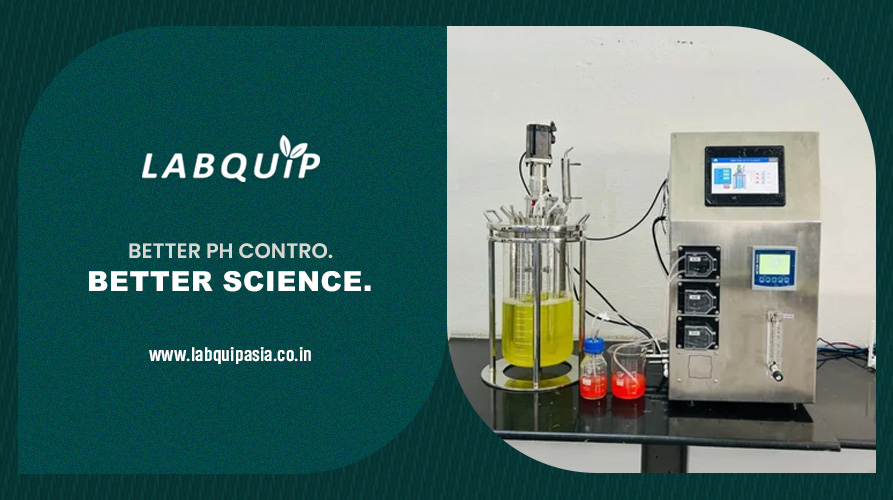
An in-line pH probe measures the culture environment in real time. Whenever the pH begins moving away from the selected setpoint, integrated peristaltic pumps automatically dispense acid or base to restore the desired conditions. These adjustments occur immediately, often before the cells experience measurable stress.
Advanced systems combine automated fermentation, continuous pH monitoring, and intelligent bioprocess control to maintain a highly stable environment from inoculation through harvest.
Many research-grade bioreactors also integrate dissolved oxygen bioreactor control, temperature regulation, agitation, and aeration into a single platform. This coordinated control strategy ensures that multiple environmental parameters remain stable simultaneously, reducing variability across experimental runs.
Another significant advantage is complete data logging. Every pH adjustment, oxygen fluctuation, and process parameter is recorded automatically, providing researchers with valuable information for troubleshooting, optimization, publication, and future process development.
Rather than reacting after problems appear, automated systems prevent them from occurring in the first place.
Choosing the Right Bioreactor for Research Laboratories
Research laboratories today require far more than simple fermentation vessels. Whether the work involves microbial fermentation, mammalian cell culture systems, or bioprocess optimization, maintaining consistent environmental conditions is essential for producing reliable results.
Modern laboratory fermentation equipment is specifically designed to support academic institutions, biotechnology startups, pharmaceutical R&D teams, and industrial research laboratories. Compact footprints, intuitive software, and scalable working volumes make these systems practical for both early-stage research and advanced process development.
Selecting the right lab scale bioreactor is not simply an equipment decision—it is an investment in reproducible science. A system with reliable bioreactor pH control, continuous monitoring, automated data logging, and integrated environmental control enables researchers to generate consistent data while reducing failed experiments and unnecessary delays.
For laboratories aiming to improve productivity, accelerate research, and build confidence in every fermentation run, investing in the right bioreactor can make a measurable difference.
Final Thoughts
Every unsuccessful fermentation experiment has a cause, and uncontrolled pH is often one of the least visible yet most influential factors. Stable environmental conditions allow microorganisms to perform exactly as intended, transforming inconsistent observations into reliable scientific data.
If your laboratory is experiencing inconsistent fermentation results, repeated experimental variation, or challenges during process scale-up, it may be time to evaluate whether your current system provides the level of bioreactor monitoring and bioprocess control your research demands.
Labquip Asia offers advanced laboratory bioreactor solutions designed to support reliable fermentation, reproducible research, and long-term scientific success.
Frequently Asked Questions
Q.1: How much pH drift is considered harmful during fermentation?
Ans: Even a deviation of 0.2–0.3 pH units can affect enzyme activity and metabolite production. Research applications generally require pH to remain within a narrow range for consistent results.
Q.2: Can manual pH adjustment replace automated control?
Ans: Manual correction may work for basic experiments, but it cannot provide the consistency, response time, or continuous monitoring required for reproducible research and process optimization.
Q.3: Does pH influence dissolved oxygen?
Ans: Yes. Changes in pH affect cellular metabolism, which in turn influences oxygen consumption. This is why advanced bioreactors regulate both pH and dissolved oxygen simultaneously.
Q.4: Which bioreactor is suitable for research laboratories?
Ans: A lab scale bioreactor with automated pH control, dissolved oxygen regulation, data logging, and scalable working volumes is ideal for microbial fermentation, cell culture, and bioprocess research.