
Still Using a Ruler for Antibiotic Testing in 2026?
Why Labs Are Switching to TRINITY V3 Antibiotic Zone Readers
The Silent Gap Between Advanced Testing & Manual Measurement
Laboratories today operate in a world driven by rapid diagnostic innovation, regulatory expectations and the growing urgency of antimicrobial resistance. Sophisticated workflows, automated incubations systems and advanced microbiology protocols have become standards practice across research and clinical environments. Yet, despite this evolution one critical step often remains rooted in the past—antibiotic zone measurement.
Many laboratories still rely on manual tools, treating the zone of inhibition reader process as a routine task rather than a precision-dependent operation. This creates a disconnect. While testing capabilities have advanced, the measurement process continues to depend on human judgment, introducing variability at a stage where consistency is non-negotiable.
In a discipline where even the smallest deviation can influence outcomes, this gap is not just operational—it is structural.
The Data Labs Don’t Talk About — But Should
Manual measurement is not merely outdated; it is inherently inconsistent. Clinical frameworks such as CLSI guidelines and global health observations from WHO emphasize reproducibility in antimicrobial susceptibility testing, yet practical execution often tells a different story.
Studies and lab validations have shown that manual zone reading can vary by ±1–2 mm between technicians, especially under varying lighting conditions or interpretation differences at zone edges. That variation may seem negligible—until it shifts a result from susceptible to resistant.
In high-throughput environments, where multiple technicians handle dozens of samples daily, this inconsistency compounds into a systemic issue.
If your lab depends on manual interpretation, how many results are quietly drifting without detection?
This is not a failure that announces itself.
It is a deviation that hides inside “acceptable variation.”
Why Manual Antibiotic Zone Reading Is No Longer Sustainable
The use of manual tools within antibiotic susceptibility testing equipment workflows introduces friction at every level—accuracy, efficiency, and standardization.
Different technicians may interpret the same inhibition zone differently. Fatigue, workload, and environmental conditions further influence readings. Over time, this leads to:
- Operator-dependent inconsistencies in results
- Reduced reproducibility across batches
- Slower turnaround times in high-volume labs
- Increased difficulty in audit documentation and traceability
What once worked in controlled environments begins to break down under modern laboratory demands. And in an era where results must be defensible, repeatable, and digitally traceable, manual measurement struggles to keep pace.
Disk Diffusion Remains Reliable—But Measurement Must Evolve
The disk diffusion method continues to hold its place as a trusted standard in microbiology. Its scientific integrity is not in question. However, the tools used to measure outcomes have not evolved at the same speed.
Today’s laboratories require more than accurate testing—they require accurate measurement systems that support:
- Consistent interpretation across operators
- Digital recording for compliance and audits
- Faster processing without compromising quality
The limitation is no longer the method.
It is the measurement approach supporting it.
The Rise of Automated Antibiotic Zone Reader Systems
A clear transition is underway across forward-thinking laboratories. Manual rulers are being replaced by automated antibiotic zone reader machines designed to eliminate subjectivity and improve reproducibility.
These advanced systems enhance the antibiotic zone measurement system by integrating digital imaging, automated edge detection, and standardized analysis outputs. The result is not just convenience—it is measurable consistency.
For laboratories exploring an automated antibiotic zone reader in India, this shift represents more than technological adoption. It is a strategic move toward operational excellence, ensuring that results remain consistent regardless of operator, workload, or testing volume.
TRINITY V3 Antibiotic Zone Reader — Precision Without Compromise
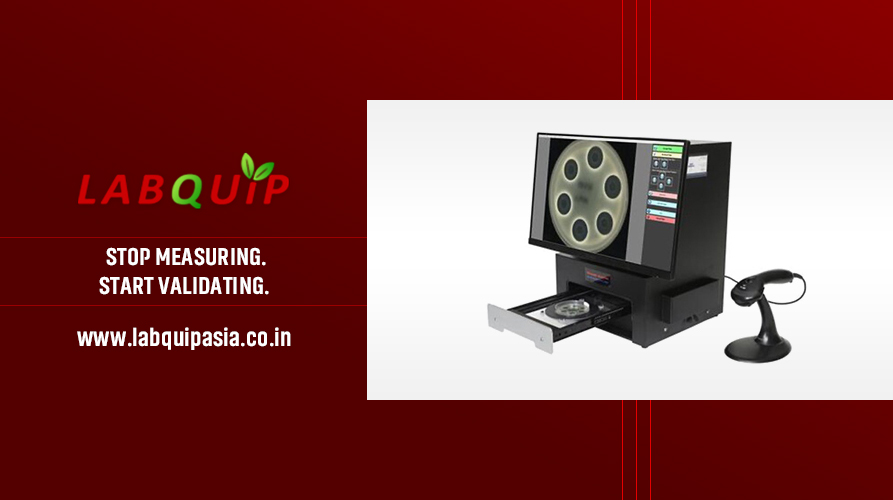
The TRINITY V3 antibiotic zone reader stands at the center of this transformation. Designed to address the limitations of manual measurement, it introduces automation into a process that has long depended on estimation.
Unlike traditional tools, this digital antibiotic zone reader delivers:
- Automated and reproducible zone of inhibition measurement
- High-resolution detection for improved analytical clarity
- Seamless workflow integration within microbiology labs
- Reliable performance for AST zone reader system requirements
For laboratories handling critical testing, the TRINITY V3 antibiotic zone reader ensures that measurement is no longer a variable—it becomes a constant.
Antibiotic Zone Reader Price vs Cost of Inaccuracy
One of the most common questions laboratories ask is straightforward:
What is the zone reader system price?
But that question only scratches the surface.
Because the true cost lies not in purchasing an antibiotic zone reader machine, but in continuing without one. Manual processes introduce hidden expenses that accumulate over time:
- Repeated tests due to inconsistent measurements
- Delays in reporting and decision-making
- Compliance challenges during audits
- Risk of misinterpretation affecting clinical outcomes
When evaluating the TRINITY V3 antibiotic zone reader, the conversation must shift from price to value. Laboratories working with a trusted antibiotic zone reader supplier in India recognize that accuracy, consistency, and efficiency are not expenses—they are operational necessities.
The Cost of Staying Manual Is Already Hitting Your Results
Let’s be direct.
If your laboratory still relies on manual measurement, the margin for error is already influencing your results—quietly, consistently, and cumulatively.
And that is what makes it dangerous.
Inaccuracy rarely appears as failure. It appears as variation that goes unquestioned.
Over time, this variation erodes confidence in data, slows workflows, and creates vulnerabilities during validation or audit processes.
The longer manual methods remain in place, the deeper this gap becomes.
It’s Time to Upgrade—Before Inconsistency Becomes Your Standard
The shift toward automation is not a trend. It is a correction driven by necessity.
The TRINITY V3 antibiotic zone reader enables laboratories to eliminate subjectivity, standardize results, and align with modern expectations of microbiology testing.
Whether you are evaluating the zone reader system price or searching for a dependable antibiotic zone reader supplier in India, the decision is no longer about adopting new technology—it is about protecting the integrity of your results.
👉 Looking to buy antibiotic zone reader systems?
👉 Explore Labquip Asia advanced solutions for your microbiology lab.
FAQs
1: What is an antibiotic zone reader?
An antibiotic zone reader is a specialized device used to measure the zone of inhibition in microbiology testing, helping determine the effectiveness of antibiotics against microorganisms with improved accuracy.
2: What is the price of TRINITY V3 antibiotic zone reader in India?
The price of the TRINITY V3 antibiotic zone reader depends on configuration, features, and supplier support. Laboratories should evaluate long-term value, including accuracy, efficiency and compliance readiness, rather than focusing solely on upfront cost.
3: how does TRINITY V3 antibiotic zone reader compare to manual zone reading?
The TRINITY V3 antibiotic zone reader eliminates subjectivity through automated detection and digital analysis, ensuring consistent, reproducible result that manual measurement cannot reliably achieve.
4: Which labs should upgrade to an automated antibiotic zone reader?
Laboratories performing frequent antimicrobial susceptibility testing, handling high sample volumes or requiring standardized reporting will benefits significantly from an automated antibiotic zone reader system.
5: Where can I find an antibiotic zone reader supplier in India?
Laboratories can connect with authorized suppliers offering systems like TRINITY V3 to ensure quality assurance, technical support and compliance-ready solutions.