
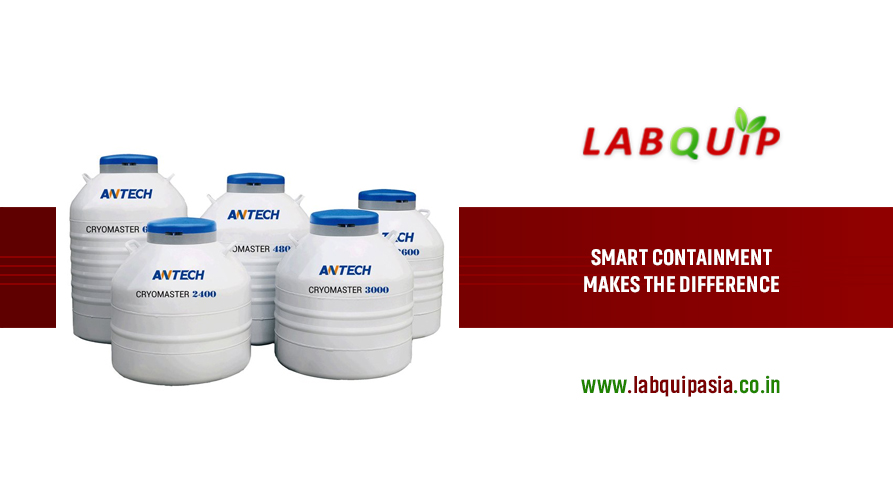
Common Mistakes While Using a Liquid Nitrogen Container (And How the Right Cryocan Prevents Them)
There’s a quiet belief inside many laboratories—if the liquid nitrogen container is holding temperature, everything must be fine.
Comforting, isn’t it? And dangerously misleading.
Because in cryogenic storage, failure rarely announces itself. It creeps in—through unnoticed evaporation, compromised insulation, careless handling. And by the time it becomes visible, the damage is already done.
So, the real question isn’t whether you’re using a liquid nitrogen container…
It’s whether you’re using it correctly, or merely assuming it’s working.
Let’s dismantle the most common mistakes—and more importantly, understand how the right cryocan quietly eliminates them before they escalate.
Mistake #1 – Treating Every Liquid Nitrogen Container the Same
Not all containers are built equal, yet many labs behave as if they are.
A liquid nitrogen storage container is not just a vessel—it’s a system engineered to maintain ultra-low temperatures with stability. But when decision-makers prioritize cost over design, they end up with containers that look similar on the outside yet behave very differently under real conditions.
Poor-quality containers often suffer from inconsistent insulation, higher evaporation rates, and reduced holding time. On paper, everything appears acceptable. In reality, the storage environment becomes unpredictable.
The right cryocan container, however, is designed with advanced vacuum insulation that minimizes nitrogen loss and maintains consistent internal conditions. It doesn’t just store—it preserves.
Mistake #2 – Ignoring Evaporation Rate Until It’s Too Late
Here’s a question most users don’t ask often enough:
How fast is your nitrogen actually evaporating?
Evaporation isn’t a flaw—it’s physics. But excessive evaporation? That’s a design problem.
Many labs using standard LN2 containers fail to monitor evaporation trends. Over time, this leads to increased refill frequency, higher operational costs, and more critically—temperature instability.
A high-quality cryogenic container is engineered to control evaporation through superior insulation and structural integrity. The difference isn’t dramatic in a day—but over weeks and months, it becomes the line between reliability and risk.
Mistake #3 – Improper Handling That Compromises Safety
Liquid nitrogen isn’t forgiving.
Handling a liquid nitrogen tank without proper awareness can result in cold burns, pressure hazards, and even structural damage to the container itself. Yet, in busy lab environments, shortcuts become habits.
Lifting incorrectly, exposing the container unnecessarily, or using incompatible accessories—these small actions quietly degrade both safety and performance.
Modern cryocan designs address this by incorporating user-friendly handling features, secure lids, and ergonomic structures. The goal is simple: reduce human error by design, not just by instruction.
Because let’s be honest—procedures get ignored. Good design doesn’t.
H2: Mistake #4 – Using the Wrong Container for the Application
A single liquid nitrogen container cannot serve every purpose effectively—yet many labs attempt exactly that.
Storage, transport, biological preservation, IVF applications—each demands specific container characteristics. Using a general-purpose container for specialized storage leads to inefficiencies and, in some cases, irreversible loss.
For instance, cryocans used in IVF clinics require stable temperature retention over extended durations with minimal disturbance. Industrial applications, on the other hand, demand durability and handling flexibility.
Choosing the right cryocan for lab use isn’t about availability—it’s about alignment with purpose.
Mistake #5 – Overlooking Maintenance and Long-Term Performance
A common misconception:
If the container looks fine, it must be working fine.
But cryogenic systems don’t fail visibly—they degrade silently.
Micro-leaks in insulation, vacuum loss, unnoticed wear—these issues slowly reduce efficiency without immediate signs. And unless regularly checked, the performance drop goes unnoticed until it’s too late.
Reliable liquid nitrogen container manufacturers design systems that not only perform well initially but maintain stability over time. High-grade materials, durable construction, and consistent engineering standards make all the difference.
Because in cryogenic storage, longevity is not a bonus—it’s a necessity.
How the Right Cryocan Eliminates These Risks Before They Begin
So, what separates a standard container from a truly dependable cryocan?
It comes down to design intelligence.
A well-engineered liquid nitrogen storage tank offers:
- Superior vacuum insulation for minimal evaporation
- Stable temperature maintenance for sensitive storage
- Application-specific design for different industries
- Enhanced safety features to reduce handling risks
- Long-term durability that ensures consistent performance
It doesn’t rely on constant monitoring or perfect handling—it works reliably even when real-world conditions are less than ideal.
And that’s the difference between managing risk… and eliminating it.
The Realization Most Labs Arrive At—Eventually
At some point, every lab faces this moment:
A discrepancy.
A loss.
An unexplained inconsistency.
And suddenly, the question shifts from “Is our process correct?” to
“Was our storage system ever truly reliable?”
The truth is simple, though not always comfortable—
A liquid nitrogen container is not just equipment. It is a silent guardian of your samples, your research, your outcomes.
Choosing the right cryocan isn’t an upgrade.
It’s a responsibility.
Don’t Wait for Failure to Reveal the Weakness in Your Storage System
If your lab depends on cryogenic storage, then your choice of liquid nitrogen container should never be an afterthought.
Explore high-performance cryocan solutions designed for reliability, safety, and long-term efficiency.
👉 Connect with experts who understand cryogenic storage beyond specifications—and help you choose a system that works when it matters most.
❓ FAQs
- What is a liquid nitrogen container used for?
A liquid nitrogen container is used for storing and transporting liquid nitrogen at extremely low temperatures, commonly in laboratories, medical facilities, and industrial applications for biological and material preservation.
- What is a cryocan?
A cryocan is a specialized cryogenic container designed for safe and efficient storage of liquid nitrogen, often used in labs, IVF clinics, and research facilities.
- How do I choose the right cryocan for my lab?
Consider factors like capacity, evaporation rate, insulation quality, application type, and safety features when selecting a cryocan for lab use.
- Why is evaporation rate important in liquid nitrogen containers?
Evaporation rate determines how long nitrogen can be retained. A lower rate ensures stable temperatures and reduces the need for frequent refilling.
- Are all liquid nitrogen containers the same?
No, different liquid nitrogen storage containers vary in design, insulation, capacity, and application suitability, making proper selection critical for performance and safety.